
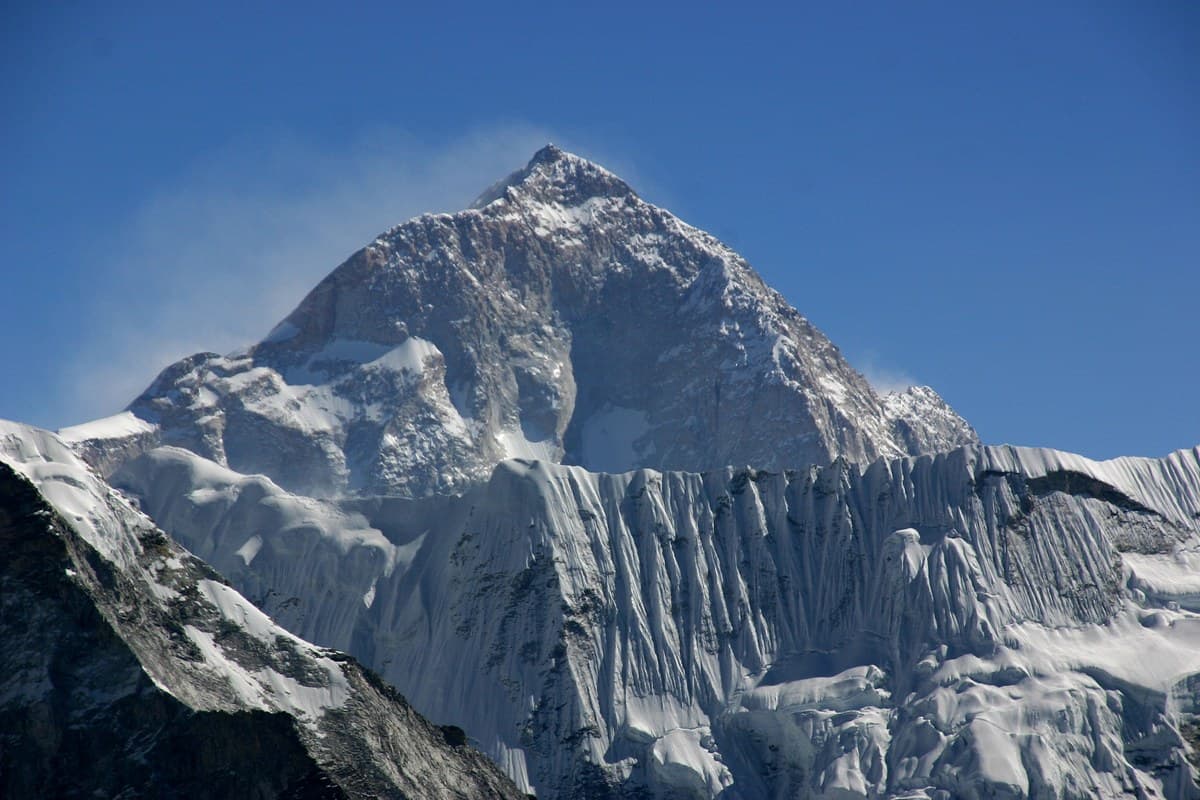
Makalu
The Great Black Pyramid • 8,485m
Overview & Geography
Rising 8,485m as an isolated four-sided pyramid of dark granite and hanging glaciers, Makalu is the fifth-highest mountain on Earth and one of the most physically demanding 8,000ers.
Situated in Makalu Barun National Park 19km southeast of Everest, Makalu stands completely isolated from surrounding giants. Its name derives from the Sanskrit 'Maha Kala', an epithet of Shiva translating to 'The Great Black'. The Makalu Barun Valley beneath the mountain is an ecological jewel containing untouched cloud forests, cascading waterfalls, and over 3,000 species of flowering plants.
Ascent History & Heritage
After exploratory attempts by Edmund Hillary in 1954, a French expedition led by Jean Franco placed ten climbers on the summit in May 1955 via the North Col and Northwest Ridge, marking one of the most successful early 8,000m campaigns.
Expedition Highlights
Fifth-highest peak on Earth with an iconic four-sided pyramid profile
Makalu Barun Valley - One of the most pristine alpine ecosystems in Asia
Shipton La Pass (4,216m) - Named after explorer Eric Shipton
Chomo Lonzo (7,804m) - Spectacular northern satellite peak visible from high camps
Standard Route
Northwest Ridge and French Couloir
Deep solitude, rugged granite arêtes, relentless wind, and dramatic transitions from subtropical jungle to hanging glaciers.
Climber Advisories & Tips
- •The trek to Makalu Base Camp (4,870m) is strenuous and remote with very few tea-houses; pack warm 4-season sleeping gear.
- •Climbers must be prepared for severe winds, technical knife-edge ridges, and steep mixed rock pitches above Camp 4.